PATCHing Teams

I explained the current PATCH methodology in my previous post. Today I’m going to do a deep dive into how PATCH views the current teams in the EPL. Here’s what the table looks like (pre-Southampton on Saturday):

Team PATCH
Chelsea 2.84
Manchester United 2.79
Liverpool 2.73
Tottenham Hotspur 2.70
Manchester City 2.68
Bournemouth 2.64
Arsenal 2.61
Southampton 2.45
Leicester City 2.38
Aston Villa 2.34
Norwich City 2.28
Watford 2.27
Palace 2.27
West Ham United 2.27
Everton 2.22
Swansea City 2.18
Stoke City 2.13
West Bromwich Albion 2.11
Newcastle United 1.97
Sunderland 1.88

The values for PATCH are the 60th percentile of all performances for each team. You could, if you were highly motivated, work out the actual units for PATCH, but treat it as abstract. 2 is around average, somewhere just under 4 is the 90th percentile amongst player performances and 5+ would be outstanding. Given that, I am reasonably happy with how this shapes up.

PATCH Correlations

At first glance the numbers above don’t look bonkers, but how does the metric correlate with other team defensive stats? Let’s have a look:

Percentile GA xGA Shots Against SoT Against
10th 0.06 0.10 0.08 0.06
20th 0.22 0.30 0.20 0.15
30th 0.28 0.44 0.38 0.30
40th 0.29 0.56 0.54 0.44
50th 0.27 0.61 0.63 0.45
60th 0.27 0.71 0.76 0.55
70th 0.19 0.65 0.71 0.48
80th 0.16 0.60 0.62 0.38
90th 0.10 0.47 0.50 0.29

Those are the R2 values each team’s PATCH values at a certain percentile (10th being the lowest 10%, i.e. worst defensive performances), compared to some traditional measures. It’s great to see that we’re nicely correlated with expected goals against and shots, though I should point out that shots do directly go into the calculation – if you allow a shot through your territory, it’s marked against you. However, that’s only a small proportion of the gains measured. I tested with shots removed from the ball progression metric just to be sure and the correlations barely went down.

Defensive Ranks

So far we’ve only looked at team’s performances en masse, as measured by PATCH. This is what things look like if we break them down by rank in a team’s formation:
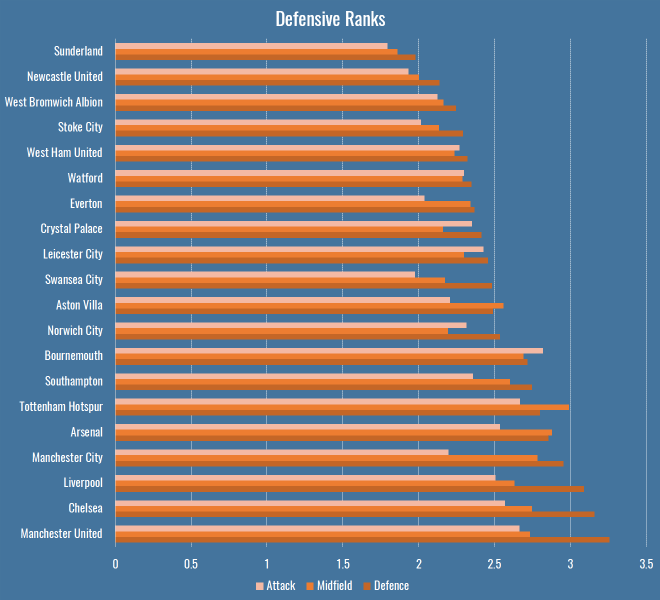
defensive-ranks

There are a few interesting patterns that immediately jump out:

  • Bournemouth’s attacking midfielders and forwards are doing a bunch of defensive work.
  • Manchester City’s less so.
  • Tottenham have the least penetrable midfield of any team in the league.
  • As you might expect, Leicester’s attack and defence are a little more robust than their midfield, reflecting the fact that they press high then retreat low.

Lingering on these numbers a little longer, I thought I’d compare these numbers to someone else’s model for a further sanity check. Mark Thompson of Every Team Needs a Ron is one of my favourite writers, and is devoted to studying defenders in all their forms. He has a system to analyse how teams convert possessions into attacks, and attacks into shots, and how they allow their opponents to do the same. I compared the defensive rank data above with his data to see what the correlations were:

Defence Midfield Attack
Attacks per Possession 0.65 0.47 0.40
Shots per Attack 0.46 0.53 0.38

So, comparing the Attack, Midfield, Defence PATCH values from the graph above to Mark’s Attacks per Possession and Shots per Attack, we can get an idea of how much different parts of a team contribute to breaking up attacks. Defensive PATCH values explain 65% of the variance in opponent attacks per possession, whereas midfield is a much lower 47%. This makes some sense, while a lot of teams would love their midfield to quash potential attacks before they happen, it’s far more common that they make it throught to the last line. What’s interesting is the second row, where midfield performances explain shots pre attack better than defence. Again I wonder if this is bad shot quality – the defence don’t (and often don’t want to) stop low-expectation long shots. However if your midfield are putting in a good screening performance, attackers won’t even get the space for bad shots.

That’s one explanation, anyway. At the very least I’m happy to see a decent correlation with someone else’s model.

Patchwork Defences

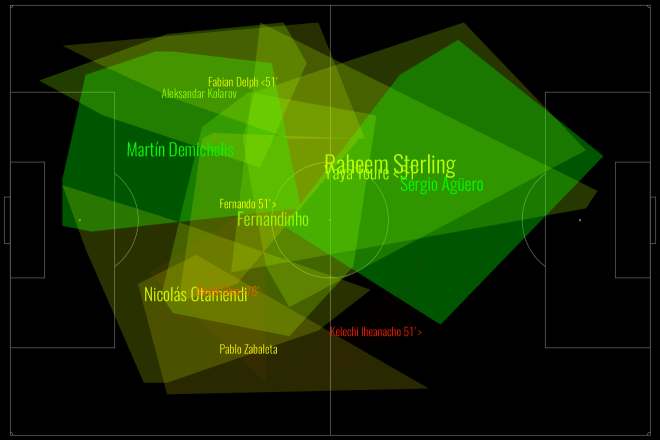
Defences are more than the sum of their parts. There are plenty of games where teams in aggregate can put in a great performance in terms of total or average PATCH values, but still be torn apart on the field. This happens often because of mistakes, which PATCH will probably never be able to account for, but it also happens because of weak links that let down the greater whole. Have a look at Manchester City from this weekend’s absolutely definitive title decider against Leicester:
defensive-areas-1901664770408076

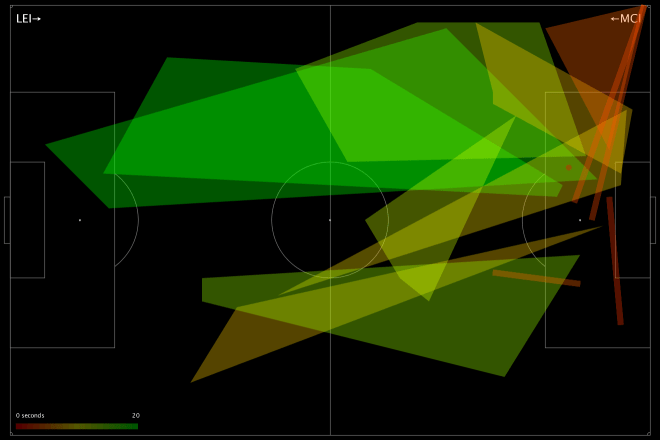
This is a fairly green chart – City policed a lot of territory, and in various parts of the pitch prevented Leicester from making regular gains. But look at their right-hand side: Otamendi didn’t score especially highly, and Zabaleta (who seems to be pushing quite far forward) scored even worse. Teams rightly fear Leicester’s right wing, because that’s where the formidable Mahrez nominally takes the field, but here we saw Mahrez pop up on the left a few times, including for Leicester’s 2nd goal, and Drinkwater also made some penetrative passes. We can see this from Leicester’s attacking chart for the day:
LEI-MCI

Very left leaning, basically nothing on the right. Despite the fact that City conceded twice from set-pieces, you still saw scare after scare from open play. The combination of a weak defensive right-hand side, and players taking higher positions than was perhaps advisable against the league’s fastest counter-attacking team (still 2nd in Europe after Caen), meant that good PATCH scores in many parts of the pitch did not necessarily add up to a good defensive performance.

Weak Links

Given what we saw in the Man City vs Leicester game, perhaps we should judge a defence by its weakest link? After all, if they’re allowing lots of ball progression in their area, that’s obviously where the opposition are attacking, whether or not they’re thinking of that player as exploitable. If we just look at the lowest score for a defender in each game (using just those with 90+ minutes in a game to be safe), this is what teams come out looking like:

Team Mean Weak Link PATCH
Chelsea 2.32
Manchester United 2.06
Arsenal 1.99
Manchester City 1.97
Liverpool 1.78
Aston Villa 1.77
Leicester City 1.74
Tottenham Hotspur 1.74
Southampton 1.74
Bournemouth 1.68
Swansea City 1.62
Norwich City 1.61
Crystal Palace 1.59
West Bromwich Albion 1.58
Watford 1.54
Everton 1.53
West Ham United 1.48
Stoke City 1.48
Newcastle United 1.45
Sunderland 1.45

Nothing radically different here, perhaps I should be a little uncomfortable seeing Villa that high, but they have save percentage and shot creation issues, not necessarily an awful defence. That said, these numbers correlate less well with each of the four measures we compared to earlier, so it seems less representative.

Total Territory

PATCH fundamentally rewards defenders for claiming territory, so lets look into any team characteristics can we pick up from looking at their territory as a whole. Who uses the most space? Who leaves the most gaps?

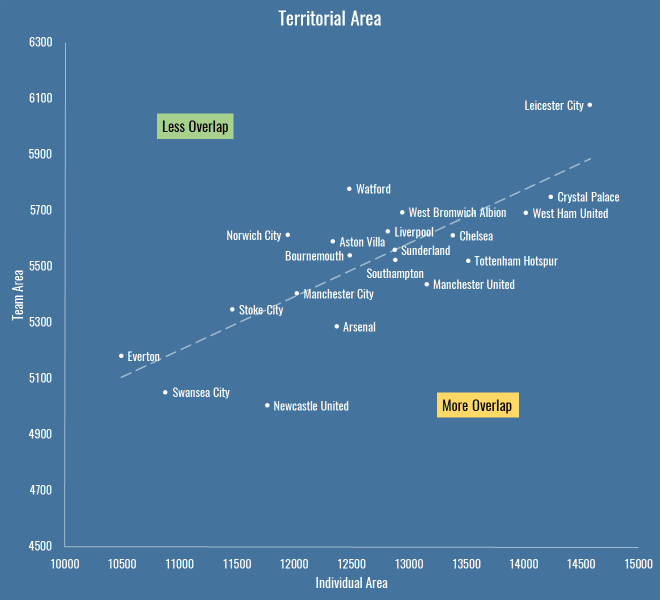
This is total area per game of players’ defensive territory for each team, measured first as the sum of individual areas, then as a merged team area:

Team Total Individual Area Team Area
Arsenal 12375 5286
Aston Villa 12338 5590
Bournemouth 12487 5540
Chelsea 13385 5612
Crystal Palace 14240 5750
Everton 10494 5181
Leicester City 14580 6078
Liverpool 12817 5626
Manchester City 12025 5405
Manchester United 13156 5438
Newcastle United 11767 5003
Norwich City 11949 5614
Southampton 12885 5525
Stoke City 11464 5347
Sunderland 12880 5560
Swansea City 10882 5052
Tottenham Hotspur 13520 5522
Watford 12482 5779
West Bromwich Albion 12943 5694
West Ham United 14022 5693

Which looks like this:

territorial-area

The X axis is the total individual area, which includes overlaps between players. The Y axis is the team shape, the area you get when you merge all the individual territories together and forget overlaps – also worth noting that the lower this value, the more empty spaces the team is leaving on the pitch.

It’s interesting because it reveals teams that are quite expansive in their defensive efforts (to the right are basically the pressers and aggressors, to the left is… Everton, asking very little of its defence). It also shows teams that have an overall compact defensive shape (Newcastle) versus those that are push up more (Leicester, Watford). Above the trend line are teams with less overlap, below are those that are more crowded when defending.

If we apply a similar sort of calculation to PATCH, we can take a team’s area and judge them not by the progression they allow through their territory, but by the progression that happens outside it. If we do that, these are the numbers we see:

Team Outside Territory PATCH
Manchester City 24.09
Liverpool 23.55
Norwich City 22.78
Southampton 22.04
Leicester City 20.77
Watford 20.75
Tottenham Hotspur 20.59
Aston Villa 20.22
West Bromwich Albion 20.19
Crystal Palace 19.37
Bournemouth 19.35
West Ham United 19.26
Chelsea 18.34
Manchester United 17.94
Arsenal 16.98
Swansea City 16.51
Stoke City 16.36
Sunderland 15.96
Everton 13.31
Newcastle United 11.28

So Man City, Liverpool and… Norwich (apparently) allow the least progression outside their territory. Newcastle and Everton leave the biggest gaps for opponents to operate inside.

Getting Goal Side

Above you saw how a lot goes on in empty spaces. The thing that worries me most about PATCH, and particularly the approach I’ve taken to trimming events for territory, is space behind a defender. Perhaps we should leave in all goal side events for a defender? Even more, should we project their territory back to the goal line, or even the goalmouth itself?

Well, you’re going to have to wait to find out. In my next post I’m going to finally get around to looking at some individual player scores, and I’ll experiment with how defenders should be blamed for goal side events then.

PATCHing Teams

Defending your PATCH

Here is Chelsea defending against West Brom in their 2-2 draw this season:

defensive-areas-1840762271078623

If I’m pointing you to this post from Twitter, it’s likely that you’ve asked, with varying degrees of alarm, what the hell you’re looking at with a chart like above. Because I’m terrible at making legends, here you go:

  • This is a chart of how Chelsea defended in the game.
  • Each shape is a player, it represents their defensive ‘territory’ – the part of the pitch they made tackles, interceptions, fouls etc.
  • The player’s name is written in the centre of their territory, and you should be able to see that some names, and their associated shapes, are bigger or smaller, depending on how much a player ranges around the pitch.
  • Each shape has a colour – this represents how much they allowed the opponent to progress through their territory: more green means the player was more of a brick wall, more red means they were more of a sieve.
  • Above, you might see that Oscar put in a ton of work and claimed a large territory – we reward players who claim a lot of territory, which is why he’s more green than some of the players he shared space with, even though he let the same opposition moves through.
  • Terry did not protect his space particularly well. Mikel and Fabregas provided little in the way of screening, and Matic, who replaced Fabregas, sat very deep but also offered little as they defended their lead.

Just as a quick sanity check on what you see above, WBA’s two goals came from a long shot from a huge empty space in front of Chelsea’s defence (left open by their midfield) and a move on Terry’s side of the penalty box:

Those are cherry-picked and don’t prove much, of course. No chart captures the entirety of a game, but hopefully you see that this is at least an interesting conversation starter to examine where Chelsea might have protected their territory better. Over the course of several games, you may notice the same patterns happening over and over again. At the same time, these are a great first stab at looking for weaknesses in an opponent’s lineup.

And that’s what you’re looking at. How does it work?

PATCH

A while back I started looking at defence in terms of how a defender prevents their opponents operating in their territory. This included a metric called PATCH (“Possession Adjusted Territorial Control Held”… yeah), which underwent several changes without me really writing it up, despite publishing all sorts of cryptic charts on Twitter. So, my plan today is to go through the whole methodology as it stands today. There’s still work to do, and it’s by no means a hard and fast measure of good and bad defending, but it’s interesting enough to share and hope for some feedback.

Defensive Territory

PATCH is all about defensive territory – where on the pitch a player is responsible for stopping their opponent. We don’t measure this in an idealised way based on formations or anything like that, all we do is look at where a player is actually defending. We take all their defensive actions and draw a line around them – that’s their territory. In the previous version, we only looked at events in a team’s own half or danger zone, so the system wasn’t great at capturing defensive midfielders, who often defend higher up the pitch. That was a problem, but one we needed to solve without including noise from things like aerial challengers on attacking corners etc. It was also a problem that if a player put in even a single tackle in a weird place (a left back on the right wing etc) then the outline of their territory grew hugely.

There are many ways to solve this, I’ve experimented with a couple. The first was to find the average point of a defender’s defensive actions, and just trim events within 1 standard deviation on the X and Y axes. The advantage of this is that it’s dead simple, very quick to do inside a database query, and the resulting area was still somewhat representative of where the player was on the pitch. But not representative enough: it was possible for players to completely disappear if their defensive actions were all taken in a large ring far enough away from the centre, and it occasionally wrongly accused players of retreating into a tiny territory. Here’s an old version of the Chelsea-WBA chart above, look how tiny everyone is, especially John Terry:

terry-bug

I then experimented with a similar approach using the straight-line distance from the centre within the same sorts of bounds, but really this just gave you a slightly more circular version of the previous box. I finally settled on decent compromise between ease of implementation and realism – I trim events to those within the 70th percentile of distance from the centre. Here’s another example, Tottenham’s 4-1 victory over Sunderland:

defensive-areas-1835048780325164.png

The one drawback over the previous version is that things look far busier, especially where there are overlaps, which is why I’ve started putting them on a black background, and increasing the transparency of lower-scoring players (because, you know, sieves are more see-through than brick walls). Departure from brand, I know, but probably more readable.

Future avenues to look at are algorithms like local convex hulls, or more probabilistic approaches. You can certainly use some sort of kernel density approach, although I appreciate having hard boundaries to territory as it is. I might be willing to sacrifice the ease of visualising territory for a better approach, however, and I’ve been looking at a fairly complex system whereby you look at defensive events and opponent buildup in previous (representative) games, and use a Bayesian system to determine the degree to which we think a player would usually be defensively responsible in that situation. I’d love to hear any other approaches people have tried.

Ball Progression

The original PATCH metric looked at how many opposition touches a defender allowed in their territory to judge how well they were doing, but this didn’t seem ideal. Some teams with a low block are happy for you to play in front of them to your heart’s content, as long as you don’t make any progress towards goal. Then there are some bad defences that just don’t take many touches to break through and score. So I’ve made a fundamental change here – we now measure ball progression through a defender’s territory. Whenever the ball is passed, or dribbled, or whatever combination of on-the-ball events happens, we look at how much progress the opposition have made towards the defending team’s goal. More than that, we look at the pace with which they’ve moved. Any player whose territory is intersected by the line of this progress gets blamed for it.

So now we’re really measuring something directly relevant – a team moving towards your goal is getting into better and better shooting positions, and preventing, disrupting or postponing this is more or less the core of good defensive work. As ever, it’s not a metric based purely on defensive actions – we still use things like tackles to help mark out a player’s territory, and we hope that there are enough of these events to get an accurate picture. But we’re not judging them on those numbers – we’re judging them in far more direct terms, based on protecting their goal.

Scoring

As with the previous metric, players are rewarded for the size of their territory , and then penalised for allowing the opposition into it, in this iteration based on ball progression. But the previous scores left me a little uncomfortable, with PATCH regularly recommending bad defences over good ones. I went back and looked in depth at the variables that went into the calculation, and especially the relationships between them.

The first thing I looked at was the possession factor, which was in there to account for the fact that teams without the ball can’t attack you. To be able to compare individual players from high and low possession teams, I normalised things to 50% possession. However it’s not as simple as that, because you might expect high possession teams to have fewer opportunities to make defensive actions, so they’d on average have smaller territories. Rather than scratch my head over it, I just looked at the numbers. It was quickly obvious was that possession really doesn’t have a reliable affect on a player’s territory. More surprisingly, the correlation with ball progression allowed is also extremely low. So, possession’s out. We’ll retcon the acronym later.

I also worried that players with large territories were being overly rewarded, and looked at a couple of different options like taking the root of the area. In the end, if you look at the data, it’s pretty much a linear relationship, but I’ve made the coefficients a little more accurate at least. I also looked at the degree to which minutes on the pitch affected defensive territory, and again, it’s almost impossible to find a reliable correlation. Therefore, only ball progressions is weighted per 90.

So that’s the algorithm – get the area, divide it by ball progression, which you weight per 90 and by pace. The bigger your territory, the better you protect it, the higher you’ll score. It looks a little like this:

(k * Area) ÷ ((Total Ball Progression ÷ Minutes Played x 90) ÷ Average Progression Duration)

That’s the gist anyway.

Caveats

This is the usual section where I list things I was too lazy to fix, but I promise I’m thinking about them:

  • There are better ways to calculate territory, but not necessarily ones that can run inside an SQL query before I get bored.
  • Players are blamed for ball progression no matter how much their territory is intersected by an opponent event. Even in the case where they hoof the ball way over your head, you still get blamed. Long term, I’d like to handle special cases like this, and assign degrees of blame to different territories.
  • I’m aware that the gaps between territories are interesting – you can defend your territory brilliantly, but still be in the wrong place. Watch this space.
  • Lots of goals, frankly, come from mistakes, which aren’t captured here.
  • Different positions might want different approaches both to territory and scoring.

It’s also worth point out a few other people working in the same space. Sander at @11tegen11 naturally has a version, with scores based on the number of defensive actions:

And David Sumpter of @Soccermatics has similar charts looking at just ball recoveries, which is fascinating to study teams’ pressing approaches:

Happy to hear any other ideas people have!

Defending your PATCH

Gary Neville’s Red Wedding

As an Evertonian, I was fascinated when Moyes went to Real Sociedad. The great Howard Kendall had enjoyed a wonderful spell in the Basque country, and Moyes seemed to start off comfortably enough. In Liverpool he won over the fans with his throwaway “People’s Club” comment, in San Sebastián all he had to do was eat some crisps.

It wasn’t to be a wildly successful stint for Moyes – he beat relegation and little else. But I kept an eye out for his results, if only because it took balls to take a job in Spain (and stay there) when Premier League clubs were calling. When Monday Night Football’s touch-screen savant Gary Neville was offered a Valencia job he had neither earned nor dreamt of, I was similarly impressed that he took the chance, but I felt even more intrigued – how could it be possible to learn on the job at a club of such magnitude?

Last night’s 7-0 massacre at the hands of Barcelona may prove to be Gary Neville’s Red Wedding moment, the young prince crowned too young and unprepared, fatally outmanoeuvred with murderous efficiency by his more experienced enemies. But at least Robb Stark won some battles along the way – what has Neville done? Valencia are winless in the league, and 14 points in 8 games off their results in the same games last season – almost 1.5 points per game lower than their previous pace. Nuno Espírito Santo led them to 10 fewer points in his 13 league fixtures compared to last season, 0.75 points per game off the pace. So you could argue things have got twice as bad under Neville, including elimination from the Champions League, and now the singular bright spot of the Copa del Rey all but extinguished.

Even before last night, it’s been slightly painful to watch at times – Neville wasn’t just an insightful pundit, he was also clear about what kind of football he might want a team under his tutelage to play, and who he hoped to emulate. He has made no secret of his admiration for Mauro Pochettino, and clearly hoped to emulate his high-pressure, high-energy approach. It’s possible there was a mix-up with the tapes though, because watching his first game against Lyon in the Champions League was that his team brought more to mind Pochettino’s predecessor André Villas-Boas – time and again they were caught high, as Lyon countered again and again, carving open the defence of one of England’s most capped defenders.

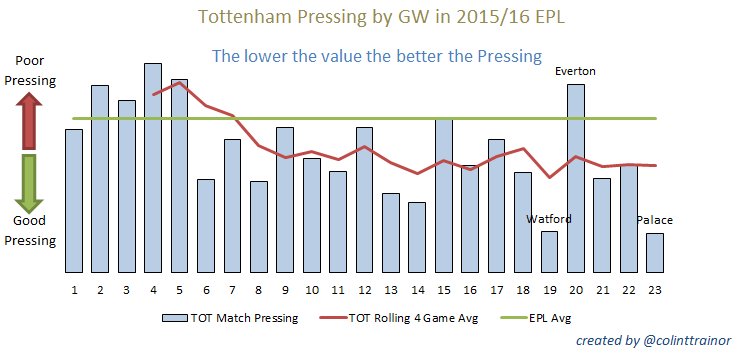
This can be forgiven – a style that relies on pressing high up the pitch takes time to develop, and Pochettino has been given that time at Tottenham. There is no doubt that’s it’s paying dividends, as pointed out by Colin Trainor recently:

But with Neville engaged in six month audition, and Valencia only five points clear of relegation at this stage, has he had any success in moulding his young squad in his image? What are the hallmarks of Neville’s time at Valencia?

  • Is he defending high? Neville’s team are performing defensive actions less than 1% further up the pitch than Nuno’s (35.1% vs 34.4%) a difference which is nullified if you include the 2014 season.
  • Is he pressing more? Valencia have gone from 5.2 passes per defensive action to 5.5 under Neville, indicating less pressing.
  • Is their tempo higher? Attacking pace has gone from about 3.4m/s to 3.6 m/s.
  • Has he perfected the wing play that Valencia want and expect from a Ferguson acolyte? Nope, same number of crosses per game on average (about 23), key passes slightly narrower if anything. He’s added a couple of successful dribbles per game, but having watched them, you’d expect that, as they rarely create any sort of overloads to offer a passing outlet.


I’ve watched them several times, and I’ll admit I am finding it hard to put a finger on what philosophy Neville has actually brought to Valencia. I asked on Twitter and nobody else seemed to have much of a clue either. Euan McTear wrote a decent piece looking at their numbers and some of Neville’s personnel changes, so I’m reluctant to go into much more depth in hope of finding answers, beyond the obvious fact that they’ve been a bit rubbish.

Rubbish but unlucky? On the face of it, expected goals doesn’t help the picture: I have them about -2.25 in expected goal difference during Neville’s stint, -0.95 under Nuno. However, it’s certainly fair to point out that Neville’s Valencia have been singularly unable to carve open a lead in the league, and perhaps this skews everything. To look into this, I ran 10,000 simulations of the shots from each of his games looking at the winner, but also the first scorer:

Home Away Home Score Away Score Home xG Away xG Home Win % Draw % Away Win % Home Scores 1st Away Scores 1st
Valencia CF Sporting de Gijón 0 1 2.07 1.26 56% 25% 19% 76% 23%
Deportivo de La Coruña Valencia CF 1 1 0.62 0.77 36% 38% 26% 38% 39%
Valencia CF Rayo Vallecano 2 2 1.14 1.72 25% 24% 51% 20% 76%
Real Sociedad Valencia CF 2 0 2.88 0.95 79% 13% 8% 62% 36%
Valencia CF Real Madrid 2 2 2.48 1.50 62% 20% 18% 43% 56%
Villarreal Valencia CF 1 0 0.43 0.66 20% 43% 37% 30% 38%
Valencia CF Getafe 2 2 1.04 0.71 42% 34% 24% 58% 27%
Eibar Valencia CF 1 1 2.78 0.53 89% 9% 3% 96% 3%
Valencia CF Lyon 0 2 1.19 1.26 38% 29% 34% 38% 55%

Note: the ‘score 1st’ columns don’t necessarily add up to 100% because of the possibility of nil-nil draws.

They conceded late – twice – to Real Sociedad, but deservedly so. They certainly could have beaten Real Madrid, the Villareal result seems cruel, and perhaps a better result against Getafe was possible. And then last weekend, the game against Sporting Gijón was notable mostly for Negredo’s series of increasingly spectacular misses.

You would have expected them to nip the first goal somewhere along the line here, and it’s possible at that point all sorts of counter-attacking preparation that we’ve never seen, cooked up on Neville’s iPads, would kick in. That not being the case, at the very least you could argue, as Neville has, that Valencia’s performances coming from behind show they still have some fight. They’re third in La Liga for points after trailing, albeit with no wins, but last night’s awful result undoes this entire narrative, barring unimaginable heroics in the second leg.

To me, it looks increasingly like his 6am Spanish lessons are only going to be useful in saying his goodbyes this Summer. Whether this proves to be a learning experience for him as a manager, or a big enough blow to his ego to send him back semi-permanently to punditry remains to be seen.

Gary Neville’s Red Wedding

Mid-Season Goalkeeper Review

Having descended into the quagmire of defensive metrics and never really returned, I thought it was about time to break my 2016 duck and publish something. Given that I occasionally spot people arguing in obscure forums pointing at the last iteration, I thought it was time to update my keeper ratings:

Keeper Mins Shots Saves Goals Save % Expected Saves ± Expected Average Difficulty Rating
Mark Bunn 188 6 5 1 83% 3.87 1.13 35.56 129.32
Fraser Forster 188 1 1 0 100% 0.86 0.14 14.45 116.89
Michel Vorm 94 1 1 0 100% 0.86 0.14 14.06 116.36
Karl Darlow 94 4 3 1 75% 2.62 0.38 34.53 114.56
Paulo Gazzaniga 187 11 8 3 73% 7.07 0.93 35.72 113.14
Alex McCarthy 565 34 29 5 85% 26.28 2.72 22.70 110.34
Sergio Romero 375 9 7 2 78% 6.47 0.53 28.14 108.24
Darren Randolph 286 12 8 4 67% 7.43 0.57 38.08 107.67
Adrián 1790 89 69 20 78% 64.11 4.89 27.96 107.62
Joe Hart 1871 60 46 14 77% 43.38 2.62 27.71 106.05
Hugo Lloris 1963 67 51 16 76% 48.10 2.90 28.20 106.02
Jack Butland 1972 100 78 22 78% 73.66 4.34 26.34 105.89
Declan Rudd 751 40 28 12 70% 26.51 1.49 33.73 105.63
Petr Cech 1967 86 68 18 79% 66.03 1.97 23.22 102.99
Kelvin Davis 95 7 5 2 71% 4.87 0.13 30.43 102.67
David de Gea 1591 64 46 18 72% 44.98 1.02 29.72 102.27
Heurelho Gomes 1948 83 60 23 72% 59.92 0.08 27.80 100.13
Thibaut Courtois 997 52 36 16 69% 35.99 0.01 30.79 100.03
Costel Pantilimon 1599 103 71 32 69% 71.01 -0.01 31.06 99.99
Kasper Schmeichel 2079 86 60 26 70% 60.21 -0.21 29.99 99.66
Artur Boruc 1604 62 38 24 61% 38.25 -0.25 38.31 99.35
Tim Howard 2069 107 75 32 70% 77.08 -2.08 27.96 97.30
John Ruddy 1316 63 38 25 60% 39.45 -1.45 37.37 96.31
Wayne Hennessey 1498 50 33 17 66% 34.45 -1.45 31.11 95.80
Tim Krul 754 49 33 16 67% 34.61 -1.61 29.36 95.34
Lukasz Fabianski 1979 85 56 29 66% 59.45 -3.45 30.06 94.19
Vito Mannone 376 23 15 8 65% 15.94 -0.94 30.69 94.09
Boaz Myhill 2077 92 63 29 68% 66.98 -3.98 27.19 94.05
Simon Mignolet 1889 65 42 23 65% 44.66 -2.66 31.29 94.04
Robert Elliot 1224 63 42 21 67% 44.82 -2.82 28.86 93.72
Willy Caballero 187 17 12 5 71% 12.83 -0.83 24.55 93.55
Asmir Begovic 1079 50 33 17 66% 35.75 -2.75 28.50 92.31
Brad Guzan 1897 99 64 35 65% 71.53 -7.53 27.75 89.48
Maarten Stekelenburg 1599 49 30 19 61% 34.38 -4.38 29.83 87.26
Jordan Pickford 93 11 7 4 64% 8.10 -1.10 26.40 86.47
Adam Federici 422 24 11 13 46% 13.16 -2.16 45.15 83.56
Adam Bogdan 93 5 2 3 40% 2.90 -0.90 42.03 69.00

So many narratives, so little time:

  • If only they’d dropped Guzan sooner – Bunn in his tiny sample has risen to the top of the class. Similarly, Southampton have finally got Forster back again and they too aren’t looking back.
  • Tim Howard isn’t that bad, get over it.
  • Petr Cech isn’t single-handedly winning Arsenal the title, get over it.
  • Jordan Pickford didn’t have the best of times deputising for Costel Pantilimon, the mathematical definition of the average goalkeeper.
  • Artur Boruc has slowly clawed his way back, and Bournemouth are no longer conceding every time their opponents so much as look at the ball.
  • Someone needs to rescue Alex McCarthy, he should have been going to the Euros this Summer.
  • Adrian is a pretty solid number 1 given the minutes under his belt.

Anyway, apologies for the wait. Lots of stuff I can’t talk about is going on behind the scenes, but there will be some cool stuff up here soon enough. Well, hopefully.

Mid-Season Goalkeeper Review

Expected Goals’ Greatest Partnerships

I thought it would be fun to have a look at players that had great chemistry through the years. Specifically: which two players generated the highest average chance quality when one passed to the other to shoot?

Here’s the top 20 producers and consumers (10 shots assisted or more):

Producer Consumer Shots Chance Quality
Luis Suárez Daniel Sturridge 13 0.2253
Gregory Van der Wiel Zlatan Ibrahimovic 11 0.2138
Franck Ribéry Mario Mandzukic 17 0.2026
Luis Suárez Neymar 18 0.2015
Theo Walcott Olivier Giroud 14 0.2009
Pablo Zabaleta Edin Dzeko 11 0.2002
Theo Walcott Robin van Persie 23 0.1998
Lukasz Piszczek Robert Lewandowski 11 0.1975
Vieirinha Bas Dost 12 0.1957
Sofiane Feghouli Paco Alcácer 14 0.1934
Daniel Sturridge Luis Suárez 12 0.1895
Thomas Müller Robert Lewandowski 21 0.1883
Jonathan Biabiany Amauri 14 0.1861
David Alaba Thomas Müller 13 0.1859
Gonzalo Higuaín Cristiano Ronaldo 14 0.1850
Ryan Giggs Javier Hernández 16 0.1846
Marcel Schäfer Bas Dost 11 0.1829
Marcelo Karim Benzema 13 0.1824
Gareth Bale Cristiano Ronaldo 47 0.1821
Alexis Sánchez Lionel Messi 21 0.1816

But this is selfish – what about reciprocal relationships? These are the highest average pairings based on chance quality created for each other:

Partnership Shots Chance Quality
Luis Suárez Daniel Sturridge 25 0.2081
Alexis Sánchez Lionel Messi 35 0.1731
Thomas Müller Mario Mandzukic 22 0.1675
Gareth Bale Cristiano Ronaldo 61 0.1664
Luis Suárez Neymar 34 0.1657
Theo Walcott Robin van Persie 39 0.1607
Luis Suárez Lionel Messi 34 0.1574
Henrikh Mkhitaryan Pierre-Emerick Aubameyang 33 0.1546
De Marcos Aduriz 29 0.1512
Aaron Ramsey Olivier Giroud 27 0.1506
Sergio García Christian Stuani 43 0.1502
Cesc Fàbregas Alexis Sánchez 24 0.1462
Jérémy Menez Zlatan Ibrahimovic 31 0.1447
Lionel Messi Pedro 53 0.1433
Karim Benzema Cristiano Ronaldo 93 0.1418
Juan Mata Fernando Torres 40 0.1414
Gareth Bale Karim Benzema 36 0.1396
Mario Götze Robert Lewandowski 41 0.1394
José Callejón Gonzalo Higuaín 38 0.1385
Raheem Sterling Luis Suárez 38 0.1383

The lesson you should take away from this? Even ignoring the biting and racist abuse, you really want Luis Suárez on your side.

Expected Goals’ Greatest Partnerships

The Case of the Missing Throughball, and Other Mysteries

Ben Torvaney noted last night that the number of throughballs per game looks like it’s been going down. It’s a pretty pronounced trend:

Count Completed Completion %
English Premier League 4450 1717 39%
2012 1655 596 36%
2013 1286 496 39%
2014 1132 460 41%
2015 377 165 44%
French Ligue 1 3738 1534 41%
2012 1605 593 37%
2013 942 378 40%
2014 825 411 50%
2015 366 152 42%
German Bundesliga 2333 1309 56%
2012 1115 550 49%
2013 715 432 60%
2014 401 254 63%
2015 102 73 72%
Italian Serie A 4985 2114 42%
2012 2789 1123 40%
2013 971 478 49%
2014 943 400 42%
2015 282 113 40%
Spanish La Liga 5601 2010 36%
2012 2146 745 35%
2013 1478 549 37%
2014 1559 557 36%
2015 418 159 38%
UEFA Champions League 1913 801 42%
2012 713 270 38%
2013 458 203 44%
2014 479 211 44%
2015 263 117 44%

If you were to take this at face value, it would be a hugely significant result: throughballs create high quality chances, and in the space of three or four years, defences appear to have discovered how to suppress them.

That’s obviously possible, but I strongly suspect that this is an issue with the way the data is being created. This is probably one of those things that you’re not supposed to talk about, and I don’t want to bite the hand that feeds this blog, so I hope the powers that be will consider this a good-faith bug report, and not the whining of an uppity lamprey complaining about the quality of the scraps it feeds off. Either way,  I caution you to look at any conclusions you make about a team or player’s output based on their number of throughballs over the last few years.

Just so we’re all on the same page, here’s the official definition of a throughball, which by all accounts has remained constant:

A throughball is a pass event which splits the defensive line, creating an attacking opportunity.

It’s difficult for us to confirm one way or another that a pass ‘splits the defensive line’ without watching every game. One thing we can notice from the table above is that conversion rates in some leagues seem to be going up. Perhaps that’s our first clue – is the ‘creating an attacking opportunity’ part being more strictly enforced? Perhaps failed throughballs are less likely to be throughballs.

Another clue is if you look at the next match event after a pass tagged as a throughball:

Season Clearance Interception Keeper Pass Shot
2012 10.13% 14.64% 22.58% 23.06% 13.81%
2013 7.79% 12.37% 26.83% 19.76% 17.25%
2014 8.71% 12.72% 27.17% 18.05% 18.20%
2015 6.80% 13.77% 27.27% 17.87% 20.13%

I’ve included only the types of events that seem to show a change. There are some interesting trends here:

  • Clearances have dropped as a proportion of next events. This backs up the theory that unsuccessful throughballs aren’t as likely to be tagged as such.
  • That said, interceptions have remained steady as a next event, however.
  • Balls that make it through to the keeper have increased somewhat as a proportion, up 5 percentage points from 2012-2014.
  • Throughballs that then set up a another pass have seen a big decline. Perhaps the interpretation of ‘creating an attacking opportunity’ doesn’t cover moves that aren’t as direct.
  • Shots have seen the biggest proportional rise from 2012-2014, which backs up the previous statement – the definition of throughballs seems to be increasingly focused on direct attacks.

There are possible footballing explanations for each of these trends. Maybe the Manuel Neuer effect has taken hold on goalkeeping across the leagues, keepers are pushing up and claiming the ball more, and that explains the increase in keeper touches after throughballs, for example. But overall, taking the absolute numbers, and examining some of the wider context, I’m suspicious.

If anyone can shed any light on the numbers, or has a genuinely persuasive argument that tactics have changed over the last few years, I’m all ears.

The Case of the Missing Throughball, and Other Mysteries

EGMAYO, An Injury Impact Metric

Different injuries have different impacts. In this article I am going to look at how historical injuries have affected teams from the perspective of expected goals. Given each squad member’s xG per 90, and the number of games they missed, what’s the total amount of xG that was sidelined in a season?

I call this metric EGMAYOExpected Goals Missed due to the Absence of Your Offence. Here are the top 10 EPL seasons by EGMAYO:

Season Team EGMAYO
2014 Arsenal 26.9
2010 Arsenal 23.3
2013 Arsenal 22.9
2012 Manchester City 19.4
2014 Liverpool 17.7
2013 Manchester City 17.4
2014 Manchester City 17.2
2014 Newcastle United 15.0
2011 Manchester United 14.8
2012 Manchester United 14.2

This indicates it’s not necessarily overly dramatic to point out that Arsenal’s injuries have had a big impact. Their lowest EGMAYO season was 2012, scoring 7.1, against an overall EPL average since 2010 of 6.7. Man City were title runners-up in their worst EGMAYO season:

Season Team Player Games Chance Quality per 90 Chance Quality missed
2012 Manchester City Jack Rodwell 18 0.36 6.42
2012 Manchester City Sergio Agüero 7 0.45 3.18
2012 Manchester City Micah Richards 22 0.12 2.67
2012 Manchester City Maicon 16 0.15 2.43
2012 Manchester City Mario Balotelli 4 0.53 2.12
2012 Manchester City David Silva 3 0.23 0.69
2012 Manchester City Aleksandar Kolarov 6 0.10 0.57
2012 Manchester City Vincent Kompany 7 0.06 0.42
2012 Manchester City Samir Nasri 2 0.16 0.32
2012 Manchester City Javi García 3 0.09 0.28
2012 Manchester City James Milner 2 0.12 0.23
2012 Manchester City Pablo Zabaleta 1 0.08 0.08
2012 Manchester City Joleon Lescott 2 0.02 0.03

Obviously it’d be far more interesting if we could better capture Vincent Kompany’s 7 game absence from City’s back line, or David Silva’s expected assists missed in his 3 games, but we’re not there yet, which brings me to:

Caveats

Sometimes my kids go up to a box of toys and just empty it onto the floor, play briefly with a couple of things, and then bog off to let mummy and daddy deal with it. Perhaps I haven’t made this abundantly clear, but this is very much my approach to football stats. I enjoy cutting data up, throwing it haphazardly on the floor, and seeing what it looks like, especially to other people. I intend to return to this later to clean up, but I’d like to make a few things clear:

  • This metric takes no account of the squad members that come in and replace injured players. Obviously these replacements have their own output in terms of xG, which may even exceed the injured player. Ideally, we would capture all of this in a similar way to Chad Murphy’s model, or even in more detail to capture the strength of schedule faced during each injury.
  • It takes no account of the importance of midfielders, defenders or goalkeepers. It’s only interested in the xG per 90 of a injured players, and therefore is weighted heavily in favour of strikers. I’m merely using it as one way to look beyond raw injury stats, I’m not saying it’s the final destination.
  • The EGMAYO calculation uses the same season as the injury for xG per 90, so players injured early on, or starting the season injured, aren’t measured particularly accurately.

So, I know all that, don’t point it out – I’m working on it. I just want to get this up for discussion’s sake, because it adds more context to articles like this in the Telegraph today. Comments welcome here, or on Twitter.

EGMAYO, An Injury Impact Metric

101 Weird Injury Stats

Everybody likes lists, and I’ve become interested in injury data, so today I’m going to attempt to give you ONE-HUNDRED AND ONE FORTY-THREE unbelievable and fascinating injury stats!

Some caveats before we begin: I only have access to data that’s public on the web, there’s a lot of junk so in some cases I’ve disregarded data that doesn’t seem to add up, and I’ve avoided including career-ending (or indeed life-ending) injuries and illnesses in individual stats, although they will show up in aggregate stats.

I should also point out that I am not a doctor, so I am not going to attempt to group injuries together in sensible ways beyond what’s absolutely obvious. I literally do not know what the knee bone is connected to. Do knees even have bones? What are bones? I don’t know, I only have data and find the human body disgusting. Let’s move on:

  1. Most injuries suffered by a player: 41, Franck Ribéry
  2. Most injuries suffered by a team: 409, Werder Bremen
  3. Longest individual injury: 1064 days, Shaun Barker
  4. Most days spent injured: 1568, Tufan Tosunoğlu
  5. Most days lost by a team to injuries: 15482, Werder Bremen
  6. Most injured body part: Knee, 2694+
  7. Shortest average injury: contused laceration, 4 days
  8. Longest average injury: fractured tibia and fibula, 246 days
  9. Shortest recovery time from fractured tibia and fibula: 44 days, Jan Fitschen
  10. Shortest recovery time from fractured tibia and fibula that I can check by Googling: 128 days, Neil McCann
  11. Longest recovery time from fractured tibia and fibula: 807 days, Christian Muller
  12. Most games lost in total across all leagues to an injury: 34366, Cruciate ligament rupture
  13. Most recurrences of same injury: 10, Tim Petersen, Knee injury
  14. Most different types of injury suffered: 33, Sven Bender
  15. Number of times I’ve got worried I’m not going to get to 101: 1
  16. Most injuries by league since 2012/13: 1081, German Bundesliga
  17. Least injuries by league: 231, French Ligue 1
  18. Most games lost to injury by league: 8954, English Premier League
  19. Least games lost to injury by league: 1569, French Ligue 1
  20. Most days lost to injury by league: 58457, English Premier League
  21. Least days lost to injury by league: 10201, French Ligue 1
  22. Most injuries suffered by a team in a single season: 79, Werder Bremen, 2008/9
  23. Most games lost to injury by a team in a single season: 294, Werder Bremen, 2008/9
  24. Least games lost to injury by a team in a single season: 6, Montpellier, 2011 (not entirely sure I trust the data)
  25. Most injuries suffered by an EPL team: 266, Arsenal
  26. Most games lost to injury by an EPL team: 2184, Arsenal
  27. Most games missed by an EPL player: 250, Abou Diaby
  28. Most different players injured: 85, Arminia Bielefeld
  29. Most different players injured in a single season: 30, AC Milan, 2011/12
  30. Most different players suffering same injury: 28, Austria Vienna, Illness
  31. Biggest outbreak of illness or flu at a club: 11 players, Austria Vienna, 2009
  32. Most different players suffering same injury in a single season: 13, Dundee Utd, Knee injury, 2014/15
  33. Most seasons a team has experienced the same injury: 10, Arsenal, Thigh problems
  34. Number of players relapsing within 1 game: 32, e.g. Vincent Kompany
  35. Longest time between relapses: 2732 days, Leighton Baines, Malleolar injury, 2007 & 2015
  36. Number of people who believed I would actually be able to come up with 101 of these: 0
  37. Fewest games missed for a title-winner: 6, Manchester City, 2011/12
  38. Most games missed for a title-winner: 351, Bayern Munich, 2014/15
  39. Most games missed or a relegated team: 318, Queens Park Rangers, 2014/15
  40. Fewest games missed for a relegated team: 40, Blackburn rovers, 2011/12
  41. Highest coefficient of variation among injury layoffs (10 or more incidences): 302.5%, Pneumonia
  42. Lowest coefficient of variation among injury layoffs:  37.8%, Cruciate ligament surgery
  43. R2 of career games missed to challenges (tackles, aerials, take ons): 0.0128

Okay, so, ran out of steam a bit and I think I’ve tweaked my anterior SQL ligament. If you are not satiated and have any particular stat requests, just ask on Twitter. I will of course be attempting to do some more serious work with this stuff in the coming weeks, but I just wanted to see what the data look like.

In the meantime, sort yourselves out Arsenal and Werder Bremen, you need to learn what serious pain is.

101 Weird Injury Stats

Arsenal’s Injury Woes: Changing Directions

An interesting conversation broke out on Twitter tonight about the timeless mystery of Arsenal’s injury record. Personally, I’m with Raymond Verheijen – Arsene Wenger should stop holding Running Man style training sessions with chainsaws and stuff, that’s just common sense. But what other factors might be at play?

Naveen Maliakkal wondered if something about Arsenal’s style might contribute:

I’d love to see how much recover sprinting arsenal have to do since they don’t rely enough on stopping counters high up the pitch and instead trying to recover into deep positions then from rather deep positions they attempt to counter. Essentially it seems like then play a style that relies a lot on covering large distances quickly.

This piqued my interest, and I wondered if all this running backwards and forwards might be quantifiable. So I came up with a simple approach:

  1. For every player, take the list of their touches in a game.
  2. Split them into sets of three – (1) where the player was, (2) where they currently are and (3) where they will be next.
  3. Draw a line between 1 and 2, and 2 and 3.
  4. Calculate the difference in angle between these two lines, i.e. how much the player has to turn.
  5. Sum all of this for each team in each season.

Picture some examples:

total-angle

So, three touches, all going forwards in a straight line is an angle of zero – the player hasn’t turned at all. Turning either direction, left or right, is measured the same, and of course the maximum angle is 180° if the player makes a forward touch and then goes directly backwards to make another. The numbers below are actually done in radians, but I didn’t want to frighten anyone.

Whether or not that makes sense, what it roughly measures is how much back and forth in total each team’s bodies have had to go through. Guess who put in five out of the top ten EPL seasons?

Season Team Total Angle Turned
2014 Manchester City 117061
2013 Arsenal 114293
2012 Arsenal 112857
2014 Arsenal 112388
2013 Swansea City 112267
2011 Arsenal 111055
2014 Manchester United 110062
2011 Manchester City 110017
2010 Arsenal 109965
2010 Chelsea 109663

Arsenal appear five times in the top ten – year after year, their players are changing direction more than pretty much any other team.

Now, let me throw some caution on this approach:

  • I don’t take timestamps into account, so you don’t know if there’s a second or five minutes between touches, but this is the same for all teams and is hopefully evened out in the aggregate.
  • This doesn’t capture how players actually move, as they can run sideways and backwards.
  • Arsenal would necessarily appear at the top, because they are a dominant, attacking team that has lots of possession and moves the ball around a lot (like the Manchesters and Chelseas you see up there). This is also true, but maybe playing well hurts.
  • I haven’t checked the correlation between these numbers and historical injury data. For example Newcastle don’t place highly here but are having a nightmare this season, with 10 players out. I’ll attempt to gather some data tomorrow to see what correlation exists.

But at the very least, the fact that Arsenal hover near the top of the list every single year is intriguing, and I must thank Naveen again for pointing this out.

Arsenal’s Injury Woes: Changing Directions

State of the Stats 2015

I published a survey this week, asking people about their interest in football stats and analytics, their ambitions and skills. I could and probably should have asked a lot more: it’d be cool to know where you’re all based and what teams you support, if only to confirm that statsworld is a sea of Tottenham and Arsenal fans. It would have been good to quantify just how few smart women have a voice in the football stats community.

So I dropped the ball on that, but I think we have some interesting data besides. I’ve only been writing here for a month or so, and I took the somewhat circuitous route into football stats of following Ted Knutson back when he edited a Magic: the Gathering website. Because of that, I’m intrigued as to what’s holding more people back from writing, theorising, and generally contributing to the ruckus. Let’s find out!


Responses

I got 79 responses in the couple of days the survey was up – thanks to everyone that contributed, and to those that retweeted the link! Of these responses, 13 work at clubs professionally, and we’ll look at that in more detail later.

Age

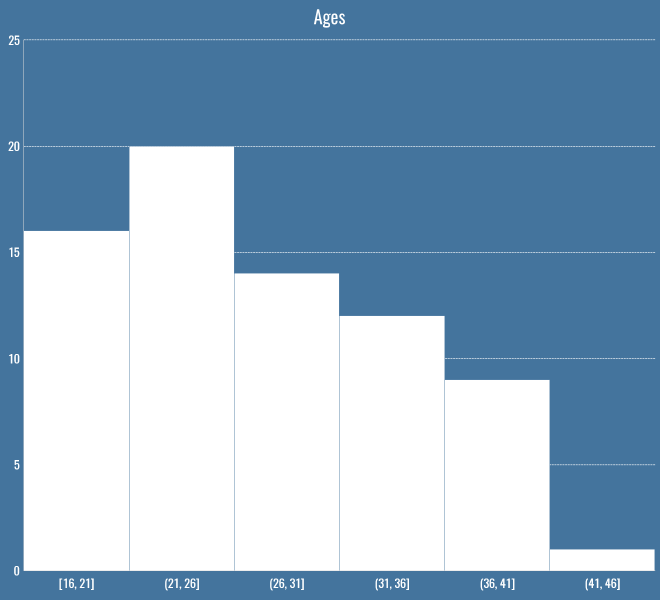
It’s a weird feature of the statosphere that everyone seems to assume everybody else is young. Scamps like the Analytics FC mandem and student-bedroom YouTube sensation Joel Salamon distract us from some of the more venerable members of the community. What’s the truth?

ages

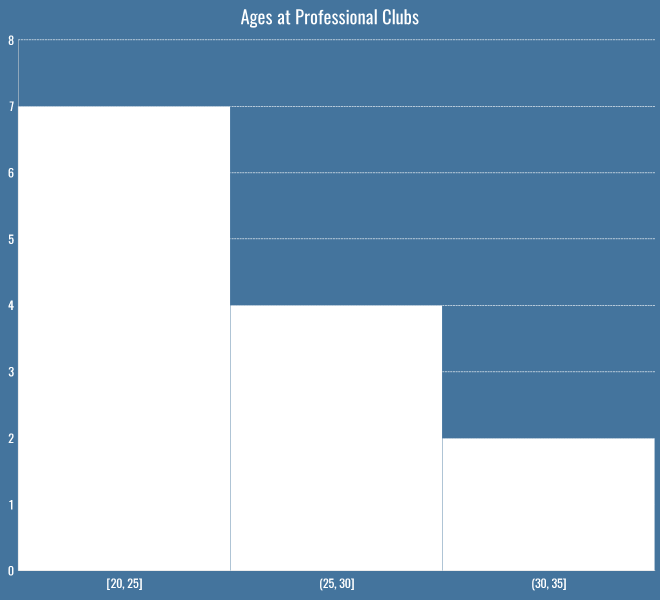
This is pretty left-leaning, and more pronounced when we just focus on the analysts at clubs:

professional-ages.png

The good news is, if you’re young and interested in football stats and analytics, the only barrier between you and clubs is how good you are and how you can get noticed. It’s also possible that most 35-year-olds don’t sit around all day filling out dumb online surveys because they have tons of work to do, I’m not sure.

Experience

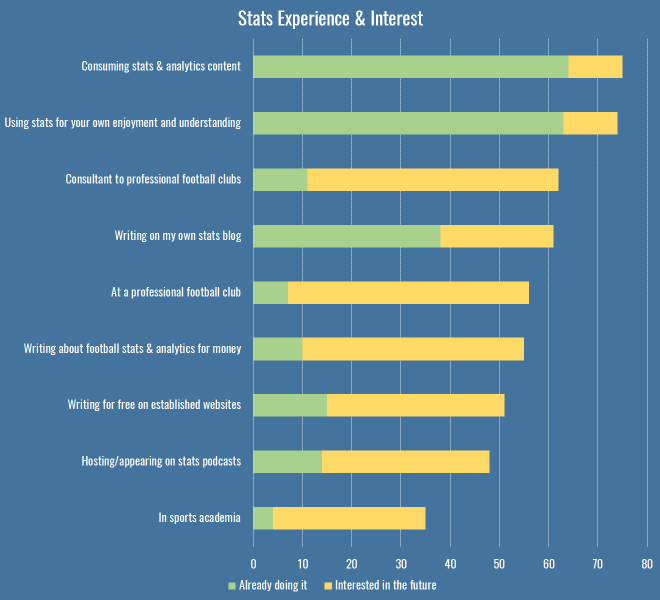
One of the survey’s main motivations was finding out how many people were already involved in doing stats work, how many wanted to be, and what might be holding them back. Let’s look at what our respondents are up to:

experience

I like the blogging numbers – it’s nice to see that people are taking the advice to just get themselves out there – a good 60% of people who can see themselves blogging about stats have already taken the leap. People aren’t lying when they say that if you make good stuff, it’ll get noticed.

People’s ambitions here are pretty clear – getting into professional football clubs is most people’s dream, but one only realised for a few at this stage. More seem to want to do consultancy than take a full-time job at a club, perhaps just because the jobs are thin on the ground – I would still assume the median number of full-time stats people at Premiership clubs is zero.

There are also surprisingly few getting paid to write about stats. Outside of the echo chamber, there clearly isn’t an enormous market for stats-heavy pieces, but it’ll be interesting to see how this number changes as time progresses and the wider media incorporate more stats content.

Also worth noting the smallish numbers of people in academia. Given the dearth of paying jobs in the media, the limited number of jobs at clubs and the generally secretive nature of cutting edge work, I personally think it’d be great to see people in academia taking more of a leadership role in the stats community, but maybe my Twitter feed isn’t representative and I’m missing stuff.

Podcasting is increasingly popular, with Analytics FC hosting a series of impressive guests, and I missed off video as a medium, which is sad because in addition to Joel’s excellent videos (and their very entertaining comments sections), I think we can all agree that this is the single greatest contribution to football analytics.

Barriers

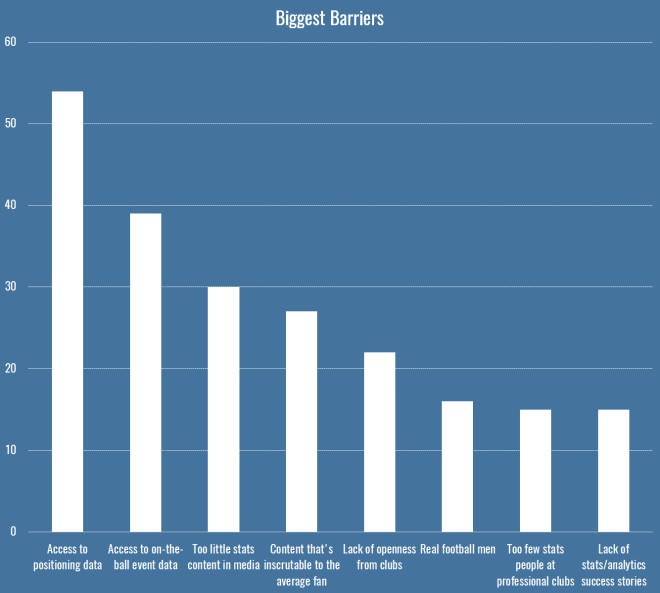
Given the hopes and dreams above, what’s holding us back? The survey asked about the biggest barriers holding back the community:

biggest-barriers

The two on the left are the most common complaints I see on the Twitter statosphere. Data is the lifeblood of stats work and it’s either very expensive to acquire, or time consuming and of dubious legality. The latter point’s important: even today, WhoScored took out a gun and aimed it at their foot in response to Joel’s latest video:

cusohocw4aakhrw

The situation gets even more complicated when it comes to positioning data, the holy grail for a lot of analysts. Clubs are in an odd situation that they have to opt-in to a sharing agreement to get positioning data about other clubs, and so there’s only a small handful that have any data at all. That’s a function of paranoia and also presumably a lot of clubs not having the resources to do anything useful with the data.

About data, I will just say this: in 10 years time, you will be able to create all the data that Opta and Prozone produce using smartphone-level video and open source computer vision software on your laptop. If someone with the resources of Google wanted to, they could do this in the next couple of years, for every match in the world. I do not believe for a second that the data side of the industry is a valuable long term investment, except in cases of really privileged information like training performances or behind closed doors in academies.

Opta and Prozone will thrive on having the best researchers working for them, in tandem with the best tactical minds at clubs. WhoScored and Squawka will thrive on having the best writers working for them, making this stuff accessible and interesting.

The best way for these companies to find this talent, it appears to me, is to free the data and hire everybody you think does something interesting with it. Maybe that’s naive.

Anyway, enough of that. Elsewhere, there is a lack of stats-focused content in the media. It’s been a year of progress – you’re almost as likely to hear “expected goals” on your TV these days as you are “rainy Tuesday night in Stoke”. It’s also been a year of recurring beef, with Neil Ashton’s seminal air-conditioning piece in the Mail and the fallout from Brentford’s misadventures in the managerial market.

All you can do is keep writing, make it accessible, and hope that narratives in the stats community pan out enough that you can build trust. I certainly think it would have been great for the media to pick up on the West Ham over-performing story, it’d be money in the bank for stats people. Make content that wins people arguments in the pub, and bit by bit people will become more accustomed to thinking about stats.

Getting Data

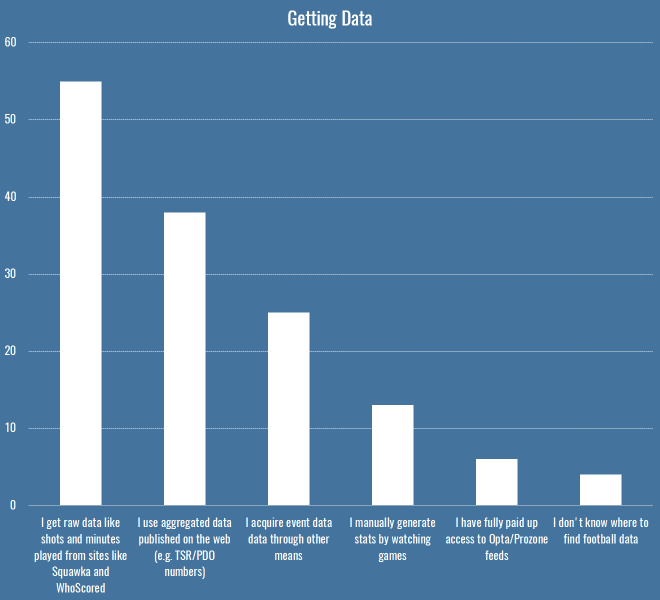
If data’s the biggest barrier to entry or progress in football stats, how are people getting it today?

getting-data

The most common thing to do is look at sites with accurate, timely raw numbers like WhoScored. Don’t scrape them and get in trouble, but do note that Squawka’s terms and conditions say this:

You are not permitted to use this website other than for private, noncommercial purposes. Use of any automated system or software to extract data from this website for commercial purposes (“screen scraping”) is prohibited. Squawka reserves its right to take such action as it considers necessary, including issuing legal proceedings without further notice, in relation to any unauthorised use of this website.

So for non-commercial purposes, maybe you’re fine. Ask your lawyer.

Kudos to the 13 people out there manually collecting stats. You can use tools like John Burn-Murdoch‘s pitch tracker to create data, and with enough time maybe you’ll have the best data in the world about set pieces or something.

In addition to these numbers, 44% of respondents to the “how do you manage football data?” say they keep a list of bookmarks to manage data. I suspect given these numbers that most people are able to judge players and teams reasonably well, looking at their shot numbers, or aggregated data like those at Objective Football. That’s a good foundation and indicates a great level of stats literacy in the community. It’s been brilliant to see the amount of stuff Paul Riley‘s been making public, as finally everyone has access to an expected goals model, raising the bar even higher.

It remains a shame that so few people have access to Opta feeds, but hopefully more and more aggregated data and tools can be made public without triggering some sort of retaliation from the owners of the data (who have paid lots of money and put lots of work into collecting it, I should make clear).

Tools

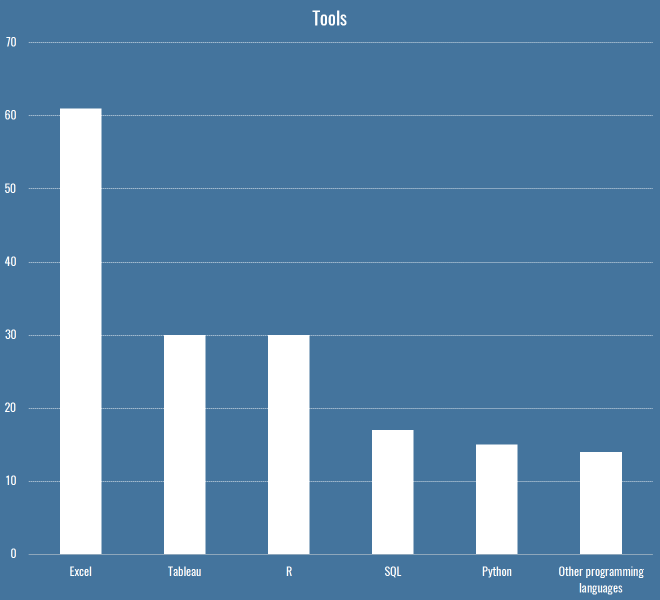
What are the secrets to doing magic with football stats? Well, no secrets, just the usual suspects:

tools

Almost everybody lives inside a spreadsheet of some sort. Tableau is pretty standard at this point, and R is about twice as popular as Python as the language of choice for stats work. Stata gets an honourable mention as it popped up a couple of times.

The SQL number is low, but I guess that reflects the fact that most people aren’t dealing with event data in bulk, or just make do with R dataframes or something. I was the only one that ticked the GIS box, and I think you’re all mad. Being able to do geometry stuff inside SQL is huge: my shot buildup charts are basically a 5-line query that runs in less than a second. If you ask me, everybody should be looking at putting stuff into SQL Server 2016 when it’s released, you get SQL, GIS functionality and embedded R, all in one platform. Get on BizSpark, it’s all free.

Modelling Knowledge

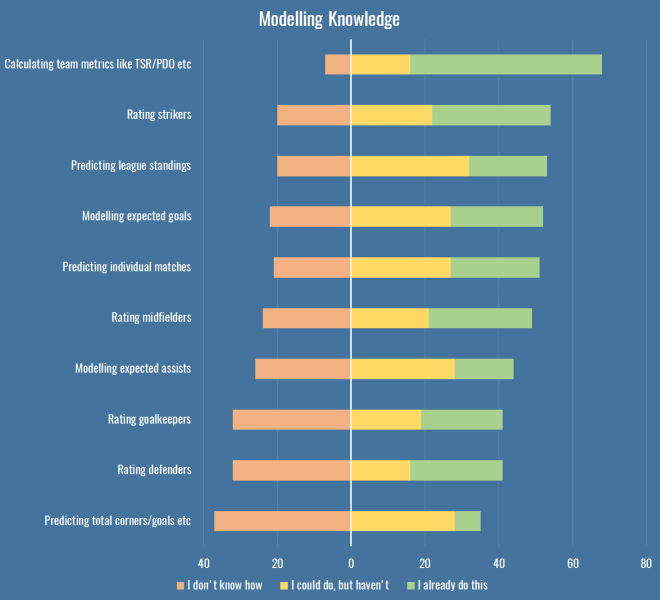
The survey had a big section asking people about the sort of metrics and models they can and do produce. I think this is one of the most important questions, because it shows where we might be falling down as a community in terms of education, but it also points at the areas that are primed for new research because fewer people are working on them.

modelling-knowledge

So on the left of zero you’ll see those that don’t currently know how to calculate a metric or build a useful model. On the right are those that know how, and indeed those that already have working models. Broadly speaking the techniques at the top are better known, and at the bottom are less known.

At the top is the simple stuff, calculating TSR and PDO is fairly straightforward, and it’s good to know how it’s done instead of just consuming the numbers. It also leads on to more advanced stuff, like calculating TSR/PDO but with xG numbers instead of goals and shots.

Strikers are, as ever, dead easy to model. Even just using surface stats like shots on target/90 and various conversion rates, you can get an idea of who’s good, who’s overperforming, and who is sustaining their performances between season.

At the other end of the spectrum, defender ratings obviously make an appearance – this is one of the hardest areas to judge, especially lacking positioning data that is key to so much defensive play.

Right at the bottom is predicting total corners/goals. This isn’t really that analytically useful, but for those of you that bet, these are big markets, and some of the easiest to find value in.

The appearance of goalkeeper ratings near the bottom is a surprise, if only because keepers are more or less the flipside of strikers. Tons of data available, clear metrics for what’s good and bad, even if you’re not using an xG-like model. I will take a moment to push my expected saves model and goalkeeper Christmas Shopping pieces.

A couple of people in the ‘other’ option mentioned working on youth models, or career predictions, which seems like a brilliant area to look into.

Education

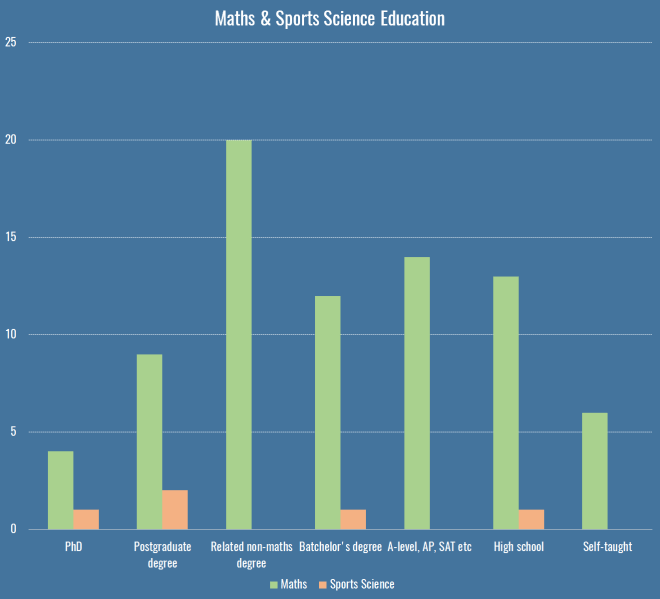
I put three questions about education into the survey, mostly because I wanted to make it clear that you can do great stats work without too much formal education, maths or otherwise.

education

About 40% don’t have a degree, and most that do weren’t necessarily in mathsy subjects, instead doing stats in the social sciences, or taking maths modules in the natural sciences or computer science etc. That said, only 2 of the 13 respondents currently working with professional clubs had less than a batchelor’s degree, so be aware of that.

There weren’t many Sports Science respondents at all, and I’d be interested from anyone with an opinion about whether Sports Science degrees serve you well for work in stats or analytics.

I also asked about coaching qualifications. 9 of you have the equivalent of a Level 1 Certificate in Football, 2 have Level 2, and we were graced by 2 UEFA B Licensed coaches.

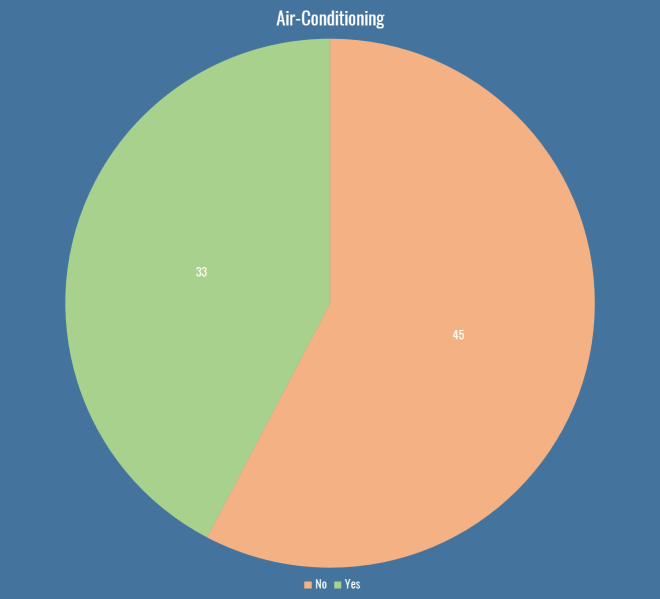
The Biggest Issue Facing The Stats Community Today

air-conditioning

The proportions remain the same inside professional clubs, and frankly I’m rethinking this whole stats career thing as a result. I’m game for unionising if you are.

Conclusions

You can download a slightly sanitized and anonymized version of the data here.

I don’t see a lot of statistically significant data pointing at surefire ways to get into paid work in football stats. But what I do see is tons of ways that we as a community could help, educate and collaborate with each other. I’d love to think that one day Alan Shearer will wake up every morning and check expected goals tables to see how the season’s going, but that’s a long way off, and in the meantime, it’s clear that there are loads of people that want to contribute more but can’t. I take my hat off to people like Analytics FC, whose podcast is putting important people and their work front and centre, and to Paul Riley, who as much as anyone seems to be trying to put his work (and importantly, his data) out in the open for people to build on. And most of all, huge props to StatsBomb, who I think served as the epicentre and catalyst for a lot of people to either start thinking about stats stuff, or even better to get off their arses and write about it.

So let’s all ask ourselves what we can do to help each other. I know there are tons of smart people out there that have great ideas but perhaps not the programming skill. I know there are great programmers who have no idea where to get data from. If anyone sees my stuff and wants to know how it came to be, get in touch, maybe I can give you some pointers.

In the meantime, one idea that I thought was worth doing straight away, was building a custom football stats search engine. My hope is that this will make it a little easier to find existing research to bring yourself up to speed, find new avenues of research, or at the very least, avoid wasting time redoing work that’s already been done. Annoyingly I’m on WordPress.com here so can’t embed it, but you can bung the following code on your site and get a search box for it:


  (function() {
    var cx = '018110615440115988629:xtvxg7sucik';
    var gcse = document.createElement('script');
    gcse.type = 'text/javascript';
    gcse.async = true;
    gcse.src = (document.location.protocol == 'https:' ? 'https:' : 'http:') +
        '//cse.google.com/cse.js?cx=' + cx;
    var s = document.getElementsByTagName('script')[0];
    s.parentNode.insertBefore(gcse, s);
  })();

<gcse:searchbox-only></gcse:searchbox-only>

Or even without script:

<form action="http://www.google.co.uk/cse" id="cse-search-box" target="_blank">
<input name="cx" type="hidden" value="018110615440115988629:xtvxg7sucik" /> 
<input name="ie" type="hidden" value="UTF-8" />
<input name="q" size="30" />
<input name="sa" type="submit" value="Search" /> 
</form>

Bookmark it, use it, tell me if there are sites missing that should be indexed. It’s not much, but it’s something I kept wishing existed, so hopefully it helps a tiny bit.

… And Relax

Thanks again to everyone that contributed to the survey, I hope the results are interesting. In six months or a year I’ll probably do this again, so I’d love some suggestions for questions for next time around.

State of the Stats 2015